
Reform UK has sparked outrage after putting forward plans which would criminalise election campaign materials in Gaelic and Scots. Another case of English supremacy within the Union…
The hard-right political party has endorsed plans to criminalise all political materials that are not written or spoken in English or Welsh. Nigel Farage‘s party has moved an amendment to a Westminster bill that would, if passed, make campaigning in other national languages illegal.
If Reform’s amendment to the Representation of the People Bill passes, those breaching the law could face jail time for up to six months. Those prosecuted could also face unspecified fines.
Reform UK’s deputy leader Richard Tice brought forward the amendment. Reform MPs Lee Anderson, Sarah Pochin, Danny Kruger, Robert Jenrick, Andrew Rosindell, and Suella Braverman all backed it.
Backlash to Reform’s English supremacism
The SNP have said that Reform UK are plotting “to crush Scotland’s native Scots and Gaelic languages“. Scotland’s ruling party has taken various measures to safeguard ancient Scottish languages. The SNP said Reform’s amendment was “despicable” and “anti-Scottish”.
The SNP Highlands and Islands representative, Maree Todd MSP, said Reform’s reactionary plans were
all too reminiscent of the brutal anti-Gaelic laws of the Highland Clearances.
This despicable anti-Scottish amendment is deeply telling – Reform want to see any trace of our native languages removed from Scottish politics.
Not content with plans to cut our MSPs and ‘review’ the powers of Holyrood, Farage and his cronies want to threaten jail time upon anyone in Scotland who publishes political materials in Scots or Gaelic.
Todd called on Reform to “do the right thing”. The MSP for Highlands and Islands, where more Scots speak endangered minority languages, said Reform must:
apologise to the people of Scotland for attempting to criminalise election materials written in Scottish languages.
She demanded the party “immediately withdraw this outrageous amendment”.
Language specialist and journalist Sophia Smith Galer branded Reform UK’s proposal as “plainly discriminatory“. The linguist says that it targets both indigenous UK languages and multilingual communities.
Smith Galer told Byline Times:
It’s discriminatory not only to the other indigenous languages of the UK … but also to individuals who could be publishing political literature in any of the migrant languages that also have a home here.
It comes after Farage launched an attack on bilingual children in Glasgow last year, many of whom speak Gaelic. Previously, Farage bizarrely accused them of “culture smashing” the city.
Alba’s history as a multilingual country
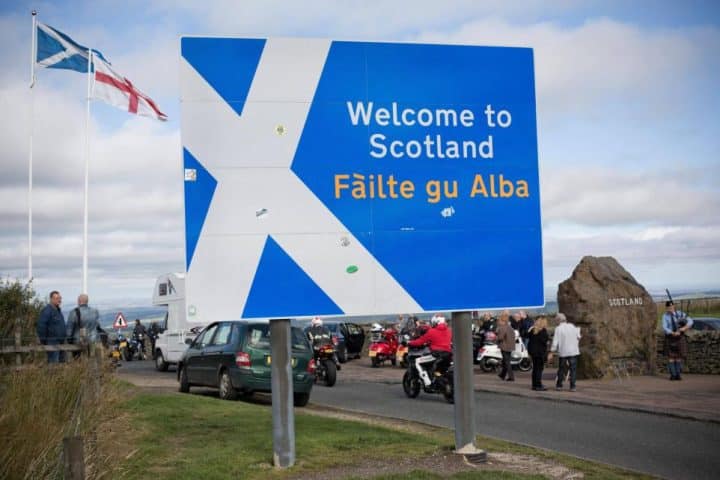
‘Alba’ is the Gaelic name for historic Scotland, seen on official signs. Gaelic was given official status alongside Scots in June 2025 via the Scottish Languages Bill, which was voted through unanimously.
Around 130,000 Scots have some Gaelic skills, according to the 2022 Census, while nearly 2.5 million have some skills in Scots. There was some argument that Gaelic was given greater priority than Scots. Last year, Emma Grae wrote in the National:
while Gaelic initiatives had a budget of at least £28 million between 2021 and 2023, Scots initiatives received just £448,000 of support…
Eventually both received the recognition they deserved in the Languages Bill. But the struggle for Gaelic and Scots language recognition is long and arduous. It has roots dating back to the “unification” of Scottish and English crowns in 1707, the early imperial period.
This article in the Scottish Left Review (re-)frames that sordid history, especially that century’s Highland Clearances, in considered detail:
In the two centuries following unification, the Anglicised Scots of the lowlands would fit into the new imperial Britain built upon capitalism, expansionism, and Protestantism. In contrast, the Gaels of west Scotland’s Highlands and Islands would be violently eradicated, along with their clan-based way of life and Celtic Catholicism.
In their place, their ancestral lands would be monetised to serve the colonial centre, and the brutally depopulated islands and dells would be mythologised as gloriously empty get-away destinations for those seeking an escape from life at the centre of empire. This is a story we are more familiar with in Ireland, and the Gaelic peoples of Ireland and western Scotland are closely connected.
… a campaign of ethnic cleansing was carried out in the western Highlands and Islands. This began with the erasure of Gaelic identity. Clan tartans were banned, as was the playing of the bagpipes. Such policies were intended to destroy Gaelic identity, born of an inherent racism held among the English and Anglicised Scots towards the Gaelic way of life.
They also served the practical purpose of diminishing clan identity and, thus, destroying the clans as a political force. The collectivist farms were broken up, and replaced with capitalist land farming – an approach familiar in the lowlands, but incompatible with the clan system of the Highlands and Islands.
… Whilst the scale of the clearances is dwarfed by the racist excesses of the British colonial project elsewhere in the world, it ought to be considered among them.
… Like Ireland, the Scottish islands are among the only places in western Europe now home to less people than at the start of the eighteenth century. The Clearances were not only an act of genocide, but an extremely successful one.
Featured image via the Canary