

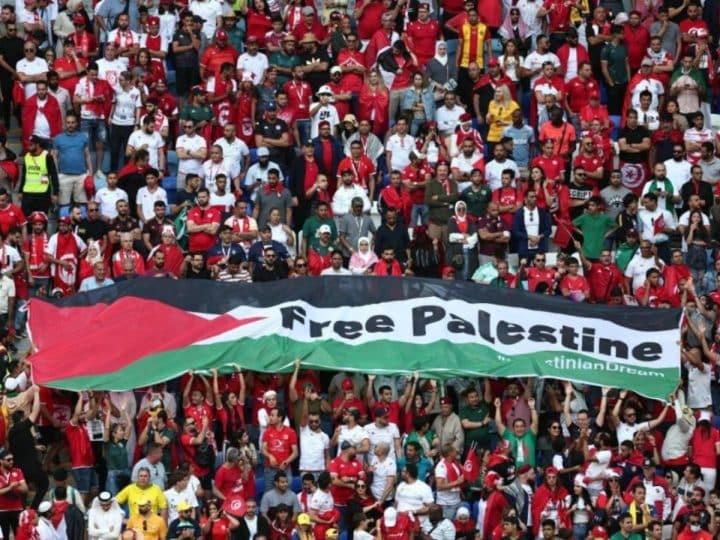
Palestine did not need a team in the 2026 World Cup to be present in the spotlight.
From the very first days of the tournament, held in the United States, Canada, and Mexico, the Palestinian cause emerged as one of the most visible topics in the public sphere surrounding the World Cup. It was seen through flags waving at public events, protests accompanying the matches, and chants of solidarity shared across social media platforms, transforming into a parallel narrative to the world’s biggest football event.
As the eyes of billions of viewers turn to the pitch, fans and activists have seized the immense media momentum of the tournament to keep Palestine in the global spotlight, reaffirming that football, as it has always been, is inseparable from the issues that occupy global public opinion.
Outside the stadiums: The Palestinian flag leads the way
If the matches are the main event inside the stadiums, the Palestinian flag has been one of the most prominent symbols outside them.
In Mexico City, at the start of the tournament, activists organised a solidarity event near the Azteca Stadium, where they formed a human Palestinian flag in a scene that drew attention and went viral across media and social platforms, becoming one of the first images associated with the World Cup outside the sporting arena.
The Palestinian presence was not limited to Mexico; it also moved to Canada, where the city of Toronto saw protests demanding that FIFA take a stance regarding Israel, while Palestinian flags fluttered among participants who seized the global event to highlight the ongoing war in the Gaza Strip.
Photos and videos of participants wearing pro-Palestine slogans also spread, turning the protests into one of the most discussed issues on the fringes of the tournament during its opening days, reflecting the activists’ determination to use the global interest in the World Cup to deliver their messages to an audience watching from various continents.
Palestine — From fan zones to stadium chants
Palestine’s presence was not confined to protest events; it extended to the fan gatherings surrounding the matches.
During fan activities related to the Qatar vs. Switzerland match, social media platforms circulated clips and images of Qatari fans raising Palestinian flags and chanting in support of Palestine. The scene repeated itself during the fan activities accompanying the Morocco vs. Brazil match, where the Palestinian flag appeared among Moroccan fans who were keen to highlight the cause around the tournament.
The most widely shared moment came from fans of Bosnia and Herzegovina during the match against Canada, after footage of chants supporting Palestine by Bosnian fans went viral, an image that reflected the widening circle of solidarity to include fans from outside the Arab world, reaffirming the status that the Palestinian cause still holds among large sections of sports fans around the world.
A message beyond football
Between the flags fluttering in the streets, the chants echoing in fan gatherings, and the protests surrounding the matches, it appears that Palestine has once again succeeded in imposing its presence on the margins of the world’s largest sporting event.
For many fans and activists, the World Cup represents not just a football tournament, but a global platform that captures the attention of billions, making it an opportunity to keep humanitarian issues in the spotlight of international interest.
These scenes served as a message from fans who chose to use the world’s biggest sporting platform to confirm that the Palestinian cause remains present in the global consciousness, and that the war in Gaza has failed to silence the voices demanding justice or to obscure the suffering of Palestinians from the world’s view.
Despite Palestine’s absence from the list of participating teams, it was strongly present in the World Cup’s public scene, through flags, chants, and messages of solidarity that confirmed that some issues can cross borders and reach the world’s biggest sporting stages.
Featured image via LeftVoice
By Alaa Shamali