

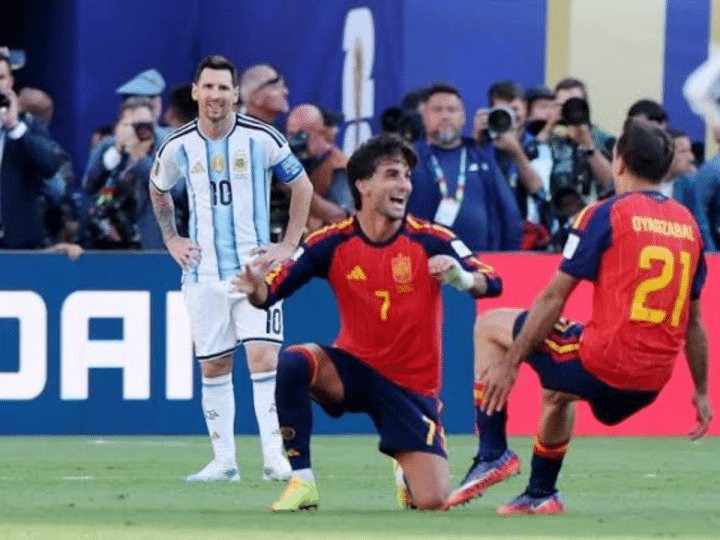
Spain’s second World Cup title did not arrive in a blaze of chaos or a flurry of goals. It came through something far more familiar, control. Luis de la Fuente’s side beat Argentina 1-0 in extra time in New Jersey. Ferran Torres delivered the decisive moment, but the story of this final was written long before the ball hit the net. Spain dominated every phase, every rhythm, every inch of the pitch. This was a victory for football philosophy.
Spain dominated
The match never resembled the dramatic, end‑to‑end final of 2022. It never threatened to. Spain imposed their game immediately, pinning Argentina back and suffocating any attempt to build through Lionel Messi or Julián Álvarez. Every attack flowed through red shirts. Every loose ball seemed to fall Spain’s way.
By the end of the night, Spain had taken 20 shots. Argentina had taken none. Not one. It was the most one‑sided a World Cup final as the competition has seen.
Spain completed 400 more passes than Argentina and spent almost the entire match in the opposition half. Even before Enzo Fernández’s dismissal, Argentina were chasing shadows. Messi, billed for a grand farewell, barely influenced the game. He drifted, he waited, he hoped, but he flopped because Spain never allowed him the oxygen to change anything.
Possession was a weapon
Spain’s commitment to possession football has been questioned at times over the past decade, but this tournament reaffirmed its value. They had more possession in all eight matches, including 74 per cent in their opening draw with Cape Verde. They conceded one goal all tournament.
Rodri, named player of the tournament, anchored everything. His control in midfield set the tempo, while Aymeric Laporte’s calm presence behind him ensured Spain were never exposed. But this was not a story of individuals. It was a collective machine.
When De la Fuente substituted both Rodri and Laporte at 0-0, it was very brave. Off came two of Spain’s most influential players. On came Eric García, Pau Cubarsí and Martin Zubimendi. The structure didn’t wobble. It tightened.
Unai Simón, winner of the Golden Glove, barely had anything to do. He made fewer saves across the entire tournament than Emi Martínez made in this final alone.
A new generation, same principles
Spain’s success is not a throwback to 2010. It is an evolution. Lamine Yamal and Nico Williams missed the opener but were central to Spain’s attacking threat throughout the tournament. Cubarsí, still a teenager, won the young player award. The depth is startling, but the identity is constant.
This is positional play at its purest: triangles, patience, circulation, control. It is football that demands technical excellence and tactical discipline. And Spain have it in abundance.
The reality is the team who was the best at possession based football has won this World Cup.
VARgentina overwhelmed
Argentina were never able to impose themselves. Their togetherness, their competitive edge, their emotional force, their dark arts all trademarks of Lionel Scaloni’s side. In this final those elements were irrelevant against Spain’s structure. They were outplayed, outpassed, outthought. To put it simply, they were outclassed.
Spain’s second World Cup title sits alongside their 2010 triumph and three European Championships in the last 18 years. It is a run of success built not on moments or individuals but on a belief in how football should be played.
De la Fuente’s appointment was a statement: the style stays. The principles stay. The identity stays.
This win is not just a trophy. It is validation. It is proof that, even in an era dominated by direct play, transitions and physicality, Spain’s way still works. Still wins. Still defines tournaments.
Spain: the best team won
Ferran Torres’ extra‑time finish will be remembered as the moment Spain claimed the World Cup. But the real story is the 120 minutes of control that preceded it. The passing sequences. The territorial dominance. The refusal to compromise.
Spain were the best team at this World Cup and in the final, and they played like it.
Football won, with FIFA and VARgentina humbled on the biggest of stages.
By Faz Ali