

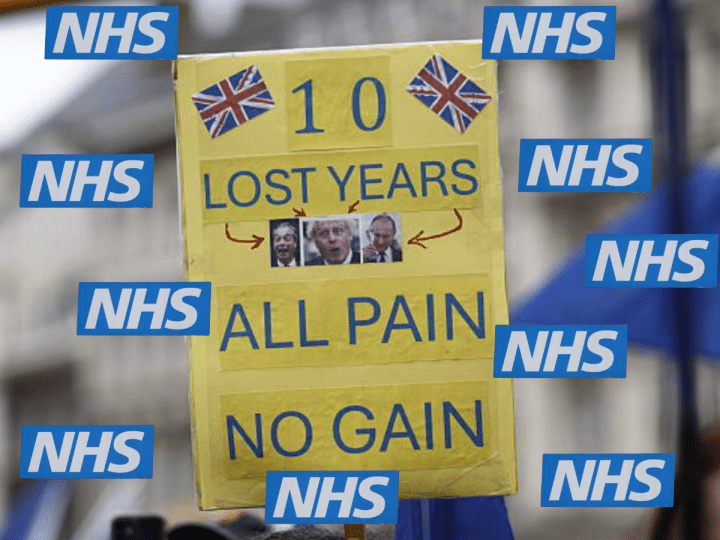
This week, as of 23 June, marks ten years since the UK public voted for Brexit — that is, to leave the European Union. Predictably, given that it was orchestrated by the likes of Boris Johnson and Nigel Farage, it’s been a proper shitshow – and there are few areas where that’s been more visible than the NHS.
One of the many cheap slogans of the Leave campaign, which now seems seared into the national consciousness, was:
We send the EU £350 million a week. Let’s fund our NHS instead – Vote Leave.
Two loosely-connected statements — one factual, one speculative — and no real promises. However, it didn’t stop Johnson repeating it over and over.
NHS: No return on Brexit promises
In 2018, two years after the vote, then-PM Theresa May announced a 3.4%-per-year budget increase for the NHS. She claimed that:
Some of the extra funding I am promising today will come from using the money we will no longer spend on our annual membership subscription to the EU after we have left.
Of course, the coming of the Covid-19 pandemic the next year meant that healthcare spending ended up being much, much higher. In real terms, the 5 years since Brexit actually took effect (fiscal year 2019/2020) have seen the UK’s total healthcare spending rise by £750m extra per week.
That sounds like a victory. However, this is because the healthcare budget ate into public spending in other areas. In the fiscal year before the referendum, the UK spent 23% of its budget on healthcare – that rose to 26% over the following 9 years. This was fuelled by record levels of taxation, not by savings from the EU.
Meanwhile, alongside that increase in healthcare’s budget share, the UK’s economy has shrunk. Of course, as ever with nebulous (some would say ‘arbitrary’) concepts like ‘how much money there is’, the actual amount it’s shrunk by is debatable. However, most economists peg the drop somewhere in the 4-8% region.
Red tape means ‘don’t cross’
However, it’s not just the amount of money in the NHS that Brexit has affected. For example, rather than clearing away red tape, regulatory separation from the EU has added hurdles for UK hospitals and patients who want to join international medical studies. In 2025, Cancer Research UK stated that:
Over and over it’s been the same: more delays; higher costs. 79% of researchers we surveyed said that since the UK left the EU it has been harder to begin new collaborations with EU-based scientists and researchers.
The most frustrated researchers tend to be those who can’t yet offer their patients a place on a clinical trial they know might provide the best hope, because of more red tape and higher costs to open the trial in the UK. In particular, this has been the case for children’s and young people’s cancer trials.
Meanwhile, the story has been similarly dire for the import and export of medications. Previously, access to the EU’s single market meant that we also had to obey the trade bloc’s regulatory rules for pharmaceuticals. Now, the UK accepts batch testing from the EU… but the EU no longer reciprocates.
Meanwhile, particularly in 2022 and 2023, the UK faced shortages of medications including hormone replacement therapies, contraceptives, antidepressants, and immunosuppressants. Whilst this was also the case in some EU countries, Brexit was a likely factor affecting both the UK and the EU.
Our own (worse) trade deals
In the Independent’s ‘Brexit Debates‘ piece on the NHS — more of a discussion, really, given that the two sides were ‘bad’ and ‘worse’ — one of the more optimistic statements that the Nuffield Trust’s Mark Dayan made was that:
It was the prospect of mass disruption in a “no-deal” departure that caused the UK to force companies to warn it about incoming medicine shortages, and ejection from the EU that caused it to demand more consistency from suppliers. The country was braced before the storm of disruption from Covid and the war in Ukraine hit, with dire effects on patients.
Note, even here, that these weren’t things that the EU was ever preventing us from doing. Brexit simply forced the UK to consider factors that we hadn’t previously explored.
Theoretically, leaving the EU allowed us to sign more international trade agreements, including for medications. Until 2024, the government maintained that the NHS would not pay higher prices for drugs. However, that changed in 2025, when the UK struck a pharmaceuticals trade deal with the US.
As the Canary previously reported:
The US-UK pharma deal made commitments for the NHS to spend more on both new and existing drugs from the States. It also lowered the bar for cost-effectiveness in NICE [National Institute for Health and Care Excellence] appraisals. This, in turn, may mean that the NHS could spend more on less-effective medicines.
Research from the Bureau of Investigative Journalism suggests that this nominally £1bn deal may end up costing £64bn. Likewise, patient-led campaign group Just Treatment and social justice organisation Global Justice Now have argued that the deal was, in fact, unlawful.
NHS, Brexit, and, of course, migration
Lastly, but certainly not least, Brexit had a major effect on the makeup of the NHS workforce itself. The Remain campaign repeatedly warned that leaving the EU would cause a sharp drop in immigration from the bloc. This, in turn, would devastate the health and social care sector, which relied heavily on staff born in the EU.
In just two years, nursing recruitment in particular saw a dramatic fall — from over 9,000 new nurses from the European economic area working in the UK in 2015/16, to under 800 in 2017/18.
As the Covid-19 pandemic struck, and with those sudden staff shortages in mind, the then-Tory government began a massive recruitment drive for health and social care staff from outside the EU. A 2025 government research briefing stated that:
Between 2010 and 2016, EU staff increased as a proportion of staff with known nationality (from 3.1% to 5.5%) while the number of Asian and African staff was static or declining.
This changed after 2016. In recent years there has been an increase in the number and percentage of staff reporting African and Asian nationalities.
The percentage of staff reporting an Asian nationality has risen from 4.1% to 9.9%, while the percentage reporting an African nationality has risen from 1.9% to 4.2%.
Of course, this in itself is no bad thing. However, as the Nuffield Trust explained:
Migration of health and care staff now fully reflects UK policy, which historically has swung wildly back and forth, instead of having consistent free movement of labour inside the EU/EEA.
Social care already reflects what might happen. After initial liberalisation allowed huge recruitment, with over 100,000 visas issued a year, a much stricter enforcement drive was followed by a battery of measures to limit migration in 2024. This saw visas falling to almost nothing.
To put it another way, Brexit has placed the NHS and the social care sector even more at the whims of UK politicians. And especially whilst hardline anti-immigration (and anti-NHS) parties like Reform gain power, and even Labour have taken an immigrant-hostile tack, that’s a very dangerous prospect.
The sorry saga of Brexit’s effects on the NHS can be summed up quite simply, as exemplified by that last point:
Leaving the EU has successfully taken the UK’s healthcare system out of the hands of unelected Brussels bureaucrats. Unfortunately, it’s put that system into the hands of British politicians — almost universally a bunch of incompetent, cruel, untrustworthy scumbags.
Three cheers for deciding our own, worse fate.
Featured image via the Canary
By Grace