
The death of a British national, Bradley Townsend, killed in Ukraine in June while fighting for Russian forces has been widely reported in the media.
“British traitor who joined Vladimir Putin’s army ‘killed by Ukraine drone’” splashed the Daily Star while former security minister Tom Tugendhat told LBC that Townsend was “extremely misguided” for “engaging in an army that is committing the most barbarous war crimes that the world has seen in decades.”
Compare this to the far more positive coverage in the media of individual British nationals who have served in the Israel Defense Forces (IDF) during a genocide that has killed more than 70,000 Palestinians.
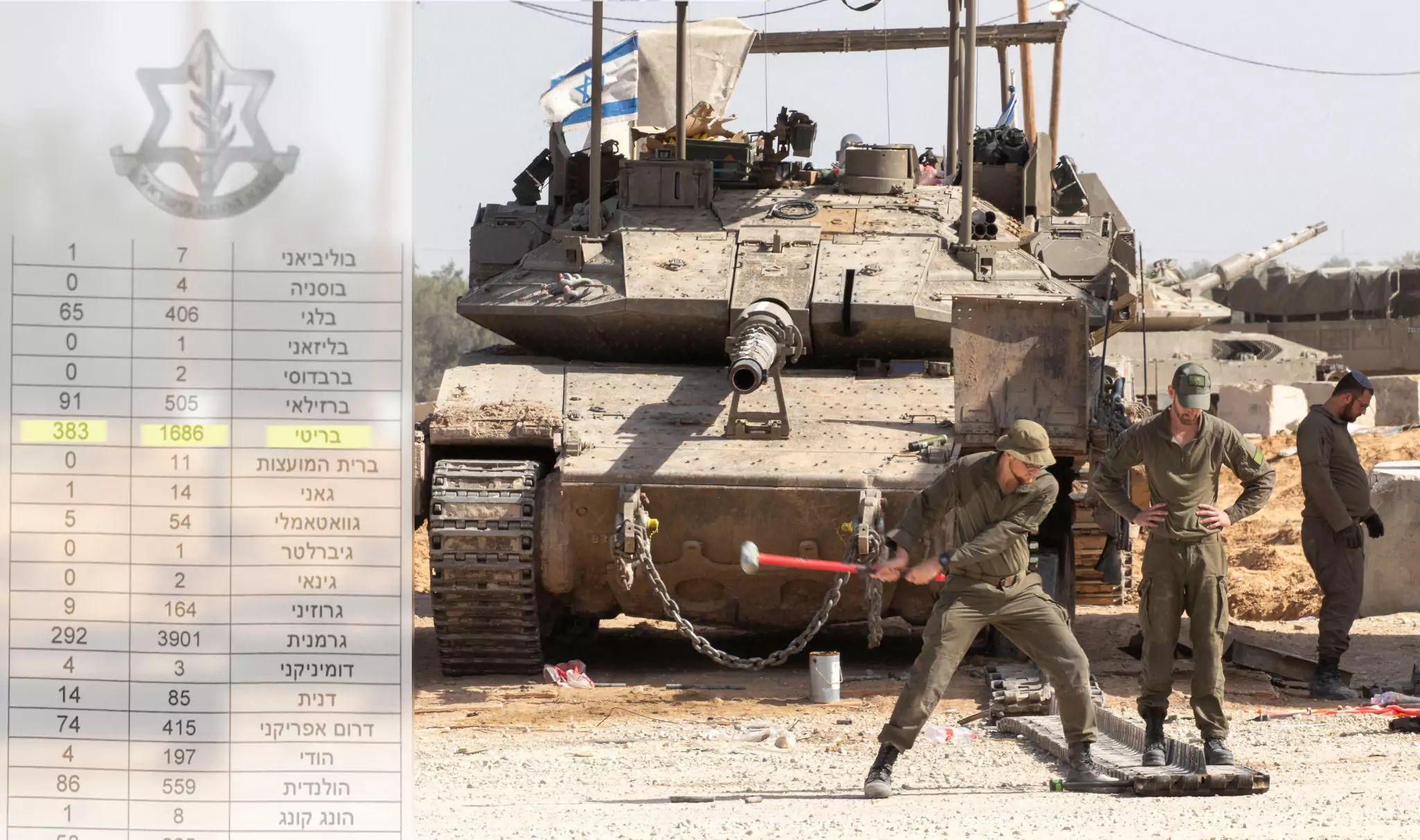
When Declassified, for example, revealed exclusively that more than 2,000 British subjects had joined the IDF since October 7, the only reference to this in the mainstream media was a short article in The London Standard.
There are, however, no stories describing British nationals as ‘traitors’ for joining the IDF, nor ministerial condemnations of subjects taking part in what the United Nations has described as “war crimes” and “crimes against humanity”.
On the contrary, British subjects enlisting in the IDF are routinely humanised and their justifications reported without criticism.
A Times story in October 2023, headlined “Meet the Britons defending ‘the only place Jews feel safe’”, described IDF soldier Sam Sank as a Tottenham fan and dog owner while also referring to another dual national, Joe, as a “Chelsea fan…camping out with an emergency supply of PG Tips tea.”
BBC News interviewed British-Israeli soldier Alex Moeller on 17 November 2023 drawing on his experience in an ‘IDF anti-terror unit’.
Moeller spoke, without rebuttal, about how Israeli forces had committed to “minimise civilian casualties and obviously minimise humanitarian impact”.
He opposed a ceasefire, describing it simply as a ‘tactical’ ploy by Hamas.
RELATED
Thugs, yobs and traitors
There was a marked distinction in the reporting of British nationals fighting for Russia, which is extremely negative, describing them as “thugs”, “yobs” and seriously misguided people.
For example, the Sun reported in November 2024 on Jay Fraser, the “Scots mercenary fighting for Vladimir Putin” while the Observer described him as a “university dropout” who was “captivated by ‘manly’ Russia”.
In March 2024, the Mirror reported on the “British traitors” fighting on the Russian side, Ben Stimson and his best friend Aidan Minnis, describing the latter as a “former National Front member and convicted thug.”
The article quotes former British army commander Colonel Richard Kemp: “These two are an absolute disgrace and are traitors who upon their return to the UK should be arrested and jailed.”
It then carries a Home Office statement saying that: “Any person who travels from the UK to conflict zones to engage in unlawful activity, should expect to be investigated upon their return.”
There are no stories that reveal similar threats being made against dual nationals fighting for the IDF other than a single reference on late-night BBC radio on 22 July 2025.
Defence journalist Tim Ripley suggested that the UK government could use a law to stop British citizens “commuting to the war in Gaza”.
The suggestion was not explored afterwards by any outlet.
Heroes in Ukraine
In contrast to the coverage of pro-Russian Britons, articles on British subjects fighting on the side of Ukraine have been far more positive.
The Sunday Times, for example, reported sympathetically about the case of ‘Baby’, a young Scot who signed up for Ukrainian forces but who, on his return from the frontline, was prevented from joining Police Scotland.
There was also blanket coverage in February 2025 – including on the BBC and Sky – of former Tory MP Jack Lopresti who joined Ukrainian forces after losing his seat in the 2024 general election.
This includes particularly sympathetic profiles in the Telegraph and Mail. The Guardian was equally positive in its account which highlighted Foreign Office advice that “it is illegal for British citizens to fight in Ukraine”.
Even though it was revealed in February 2026 that Lopresti had joined the neo-Nazi Azov Brigade, the Telegraph then carried a story the following month with the headline: “Jack Lopresti is a rare example of a politician who puts his money where his mouth is”.
The article was written by Colonel Richard Kemp, the same person who had called for the jailing of the two Britons fighting on the Russian side.
RELATED
Clear hypocrisy
Perhaps the clearest example of the hypocrisy over the coverage of Britons fighting in foreign armies was the media’s reaction to Declassified’s campaign, launched in May 2026, demanding that the government track the movements of Britons who had served in the IDF and had potentially been involved in war crimes in Gaza.
The petition, “Nobody wants to live next to a war criminal”, has now been signed by over 26,000 people including Zack Polanski, the leader of the Green Party of England and Wales.
Instead of recognising this as a story in the public interest, sections of the press immediately attacked Polanski and condemned it as an anti-semitic campaign.
The Telegraph dubbed it a ‘Jew register’ while the Express described it as ‘a ploy…straight out of Nazi Germany.’
There was, in other words, more media attention criticising Polanski’s support for the campaign than there were stories that investigated whether Britons may have been flouting the law by fighting for the IDF in Gaza.
Yet more evidence of a mainstream media that puts its ideological support for UK foreign policy above any commitment to hold the powerful to account.