

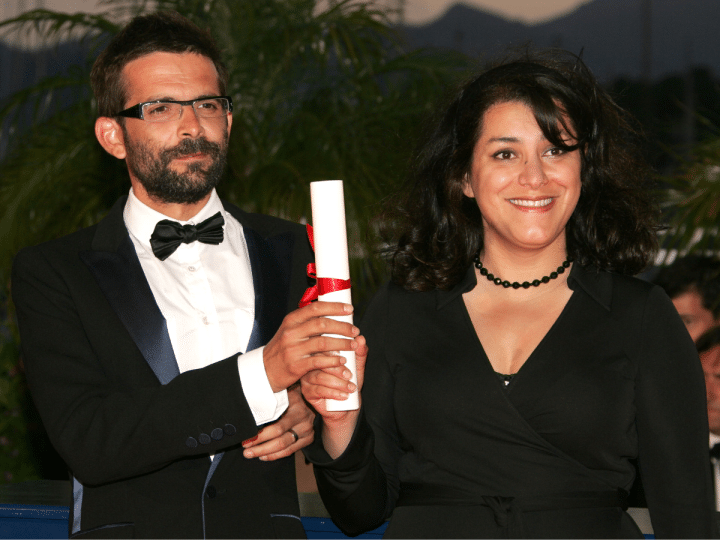
Obituaries for Franco-Iranian artist and author of Persepolis Marjane Satrapi are pouring in from Western politicians and media following news of her death in Paris at age 56 on Thursday.
Western establishments’ obituaries revealed a pattern of appreciating Satrapi for opposing Iran’s government, reflecting their ever-present instinct of Islamophobia.
“Persepolis” was a bestselling graphic novel series by Satrapi.
Most of them admire her as CNN puts it as:
an outspoken critic of Iran’s ruling establishment and a prominent supporter of the ‘Woman, Life, Freedom’ movement.
Satrapi was married to Mattias Ripa, who helped translate ‘Persepolis’ into English. He died last year.
News agency Associated Press reported a “member of her close circle” as saying she had “died of sadness” following her husband’s death.
Persepolis author mourned
Associated Press reported that President Emmanuel Macron and his wife paid “tribute to a remarkable artist who transformed an Iranian childhood into a universal fable.”
Yael Braun-Pivet, President of the French National Assembly, posted a picture with Satrapi, captioning it that France had lost “an immense artist.”
Marjane Satrapi avait fait de son œuvre un acte de liberté.
Avec Persepolis, elle avait donné un visage et une voix à la révolution iranienne, portant haut le combat pour la liberté et la dignité des femmes. La France perd une artiste immense.
À sa famille, à ses proches,… pic.twitter.com/TCnaIOnxfs
— Yaël Braun-Pivet (@YaelBRAUNPIVET) June 4, 2026
French politician Olivier Faure said the artist had given a “global echo” to the “victims of the mullahs.”
Marjane Satrapi, autrice de « Persepolis » est morte de tristesse. Elle laisse tous ceux qui l’ont aimée et admiré son œuvre, orphelins. Spiegelmann avec « Maus » avait su donner à son histoire traumatique familiale liée à la Shoah un écho mondial, Marjane Satrapi avait réussi la… pic.twitter.com/zEzK6ZA6LE
— Olivier Faure (@faureolivier) June 4, 2026
The Mayor of Cannes, David Lisnard, said Satrapi lived through “repression and deprivation of freedom under the mullahs’ regime,” applauding her for defending women’s rights where they are “most endangered in the world.”
Elle était une grande artiste. Sa bande-dessinée puis son film autobiographique, Persepolis, distingué du Prix du jury au Festival de Cannes en 2007, étaient aussi beaux et raffinés, à l’instar de la grande culture perse, que ludiques et bouleversants sur les conséquences de la… pic.twitter.com/z7tUj9MCgM
— David Lisnard (@davidlisnard) June 4, 2026
Western media
France’s Le Monde ran a few articles. They said:
Satrapi, an outspoken critic of Iran’s theocratic government, arrived in France in 1994 and gained French nationality in 2006. Persepolis recounts the story of Satrapi’s early life in Tehran, struggling under the restrictions imposed by Iran’s Islamic leadership after the 1979 revolution, before she is sent to Europe by her parents and begins a life in exile.
They also call her “a powerful and outspoken artist,” in another article, and “a brilliant, free and creative artist,” in a third article.
Germany’s Die Zeit said her comics were a means of political enlightenment.
The Washington Post, Times of Israel, and Haaretz posted the Associated Press story on Satrapi, which called her “a prominent advocate for women’s rights.”
Satrapi had worked with Israel’s film industry in the past. She was reported “enamored” with Israeli directors like Ari Folman and “friendly” with Eran Kolirin, according to Israel’s Haaretz.
The Financial Times quoted a letter that Satarpi had written she in which she said she wanted to show Western readers that Iran was not just a “country of fanatics and terrorists.”
The New York Times said her novel “illuminated the struggles of Iranians” during the Islamic Revolution
Breaking News: Marjane Satrapi, the Iranian-French author whose graphic novel series “Persepolis” illuminated the struggles of Iranians during the Islamic Revolution, died at 56. https://t.co/WQWxavBm5l
— The New York Times (@nytimes) June 4, 2026
In the end, the Western establishment’s embrace of Satrapi reveals more about them than her. These establishments love to canonise dissenters who serve their geopolitical narrative. Whilst many will mourn her art, it is no accident that the Western world chose to elevate her work.
Featured image via Getty/Gareth Cattermole
By The Canary