
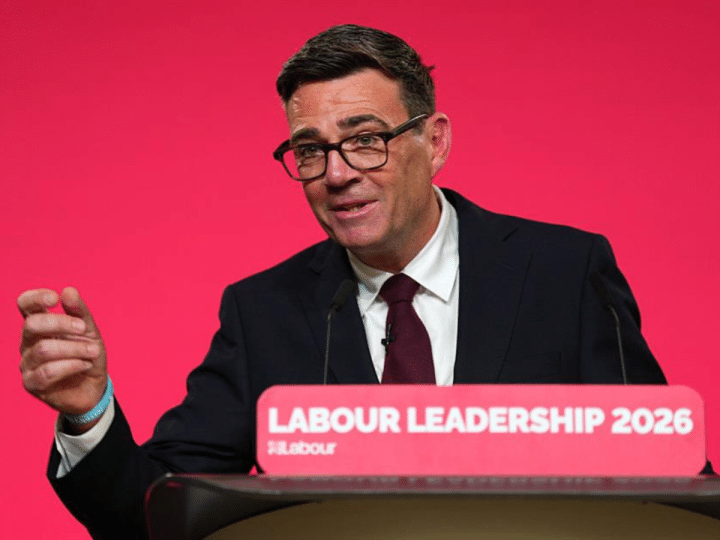
Andy Burnham is officially the new leader of the Labour Party after running the ‘contest’ completely unopposed.
To mark the occasion, a Survation poll has pegged Labour and Reform in joint lead for popularity across the country, tied at 24%.
The sudden jump in the polls owed itself to the combined effect of Labour’s increased popularity following Starmer’s resignation. Plus, Reform’s slump after scandal-struck Nigel Farage quit his seat in Clacton-on-Sea.
The former Manchester mayor turned Makerfield MP secured the backing of 379 of the Parliamentary Labour Party’s (PLP) 403 MPs. In his inaugural speech as prime minister in-waiting, Burnham hit a now-familiar note: “change”.
He said:
Change starts with honesty. We must recognise that this generation of politicians, myself included, have failed to challenge a political culture and an economic model that simply doesn’t work well enough for ordinary people. Four decades of the neoliberalism that began in the 1980s have not been kind to the places that built our party, nor to the communities across the UK in rural and coastal areas. So we pledge today to them to be better.
That posturing against neoliberalism is also Burnham’s calling card, even going so far as to claim “Manchesterism is the end of neoliberalism”. However, as the Canary’s Cameron Bailie highlighted:
Burnham says he would still obey Rachel Reeves’s fiscal rules. That means accepting the same Treasury constraints that have blocked serious public investment for decades. Can you really challenge neoliberalism while simultaneously reassuring bond markets, protecting fiscal rules, and refusing to confront financiers?
We’ll believe Burnham’s claims to oppose neoliberalism when we see him in action, but we’re not going to hold our breath here.
Burnham calls out infighting and political point scoring
Beyond that, the PM-to-be claimed he had five things “to make us better”. First and foremost, Burnham pledged to fight what he called the “insidious briefing culture” of the Labour Party.
We won’t beat Britain’s new right if we are consumed by infighting and pulling in different directions.
Of course, we’ve heard calls for party unity that quickly turned into ‘unite under my faction’ before. Keir Starmer followed precisely that trajectory, extending a hand of friendship to the Labour left before turning around to build a PLP that put out draconian right-wing policies.
Second, Burnham pledged to build “a new politics”.
He said:
The country is crying out for it. We might enjoy the point scoring against others. The public don’t. How can politicians point fingers when living standards are falling and politics as a whole, isn’t working for them? It infuriates them and makes them switch off.
As we’ll see in a minute, the new Labour leader doesn’t quite make it to the end of his speech without pointing the finger. Pointing the finger, for better or for worse, is kind of what politics is.
Burnham pointed to his Makerfield victory as an example of his “problem solving, not point scoring” approach. However, he added:
Let’s have the courage to fix the big things that politics has neglected, like social care, and have the conviction to go out there together and argue for our plans, and let’s have the self-confidence to find common ground with other parties where we can. By seeking more consensus, we may just find the change we make is more lasting.
Fixing social care sounds lovely. That being said, “seeking consensus” with a right-wing that’s racing deeper and deeper into fascism sounds like a good way to continue pushing the Overton Window off the bloody cliff.
Decentralisation and devolution
Which brings us to Burnham’s third point: the distribution of power.
As your leader, I will set a direction that is distinctively Labour. We won’t try to out Green the Greens, or out Reform, Reform, or doing what we’ve done in the past…wearing too many Tory clothes.
***
Britain took a series of wrong turns in the 1980s. Political power was centralised, and economic power was privatised. The country surrendered control of the essentials: housing, water, energy, transport, and left people exposed to higher costs, that in turn led to the concentration of more wealth and power in the hands of fewer people and fewer places.
Decentralised public control of necessities is one of Burnham’s go-tos when explaining his ‘Manchesterism’. Manchester has made nearly a billion pounds in dividends by the part-ownership of its airport by the city council, and has achieved the biggest reduction in inner-city deprivation alongside it.
However, that commitment to the redistribution of power clearly has limits. Burnham has already explicitly rejected the possibility of another Scottish independence referendum.
Meanwhile, on the subject of wealth redistribution, the Makerfield MP remained mysteriously silent on the subject of wealth taxes for a long while. However, more recently, he’s proposed a land value tax.
Tax Justice UK explained:
Burnham has also talked openly about scrapping council tax, and stamp duty, two of the most regressive, outdated taxes we have…Burnham prefers a Land Value Tax (LVT), which would also resolve the outrageous current council tax situation whereby a Blackpool family home often faces a higher tax bill than a billionaire-owned mansion in Mayfair.
Point 4.5?
Burnham’s fourth pledge was to “be a leader for the north, the south, the east, and the west, for Scotland, Wales, and for Northern Ireland“.
That was probably a necessary antidote to the likes of the Telegraph claiming that “Burnham has declared war on the South”. However, if you ask us, this bears a strong resemblance to his fifth and final point:
We will take power back from Westminster and Whitehall, and give it to the place where you live. More power over life’s essentials, so you can make them work better and more affordable for people.
***
We want to give your area more power to build the council and social homes that you desperately need for those families I was talking about a moment ago.
Actually, now we mention it, isn’t this just the third point about decentralising power again? You’d better hope he actually delivers on that redistribution of power after pledging it three times with slightly different wording.
Burnham, we want actions, not words
Burnham’s left-wing credentials don’t exactly wow the Canary. During the Makerfield by-election, we reported that:
- Burnham voiced support for Mahmood’s racist immigration changes
- His role with Iain Duncan Smith’s think tank just shows he’s more of the same
- He ditched support for trans rights to panic-grab Reform votes
- Burnham stated that he won’t renationalise Thames Water
- He called for ‘safe routes’ for asylum seekers, then agreed with Farage in muddled interview
- He sat on the fence whilst a Green candidate called out genocide
Burnham’s talk of redistributing power is all well and good, but again, we’ll believe it when we see it. Until then, you’ll have to forgive us a moment’s pleasure in watching Starmer’s departure.
So long, you worthless hack.
Featured image via Getty Images
By Grace