

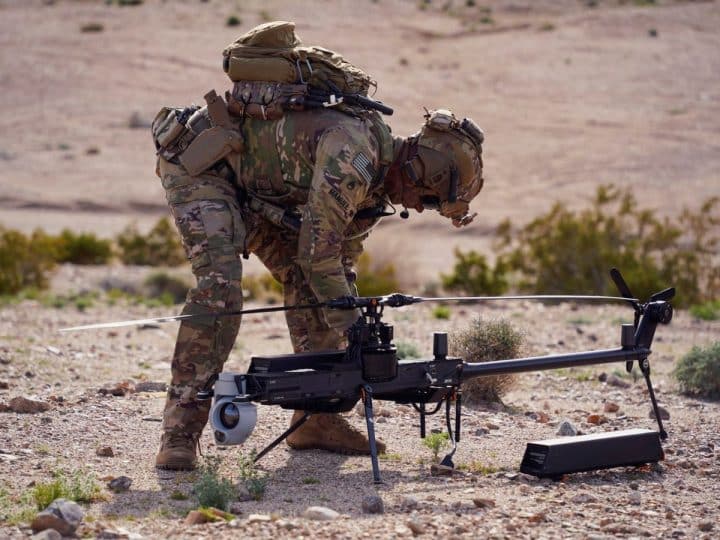
The British Army has field tested a range of new AI drone equipment. The military wants to shorten so-called ‘kill chains’ using technology from AI war firm Anduril among others. An entire infantry unit was re-purposed to train in drone warfare.
The regiment did so on UK terrain chosen to “closely resemble the heavily forested landscape of Finland”. The army’s website said:
Unlike traditional infantry units, these battalions won’t just rely on soldiers moving across the ground. Instead, they will specialise in drones and other unmanned systems to find and defeat enemies in the air and across the electronic spectrum — an area known as the “drone zone.”
Key information was collected using Anduril’s Ghost X drone — equipped with cameras and infrared sensors — as well as ARX’s Gereon ground vehicles, which can operate far forward without putting soldiers at risk.
Major Nick Machniki said:
This shortens the kill chain. We go from finding and detecting using drones to targeting and striking in a matter of minutes. We understand the battlefield more now than we ever did.
Anduril UK boss Rick Drake bragged in April 2026 that his firm would massively speed up the British Army’s ‘kill chain’.
A kill chain is the process by which targets are identified, prioritised, and hit, which you can read all about here. The UK has signed up to use an Anduril technology called Lattice.
Drake said:
The beauty of software like Lattice means we can integrate those natively and speeding up decision cycles in what we call kill chains, again, to help the Army become more lethal.
Anduril is currently working for a foothold in the lucrative Israeli market. The Jerusalem Post reported on 2 July 2026 that the firm was keen to invest in Traysar, an Israeli firm which:
produces engineering components and digging machines for use against terrorist tunnels and underground military bases.
The firm announced in 2025 it would be working on a joint US and United Arab Emirates (UAE) drone project for Omen drones:
a hover-to-cruise Autonomous Air Vehicle (AAV) that will combine the endurance, payload, and autonomy of larger systems with the flexibility of a compact, runway-independent airframe.
Anduril claims Omen will deliver:
persistent maritime domain awareness, long-range overland surveillance, and contested logistics support from ship, shore, or austere sites – extending sensor reach and mission flexibility without the runway burden of traditional airplanes.
The UK has signed a £62m war contract with Anduril. London-based NGO Action on Armed Violence warned in March 2025:
The integration of AI into warfare is moving faster than our ability to regulate it. When machines are given the power to make life-and-death decisions, we risk eroding the very principles of humanitarian law.
The UAE is currently bankrolling a genocidal war in Sudan. Israel’s excesses in Gaza and Lebanon are no secret. The UK, which has increasingly shaped its economy around warfare, finds itself in terrible company once again.
Featured image via DefensePost
By Joe Glenton