

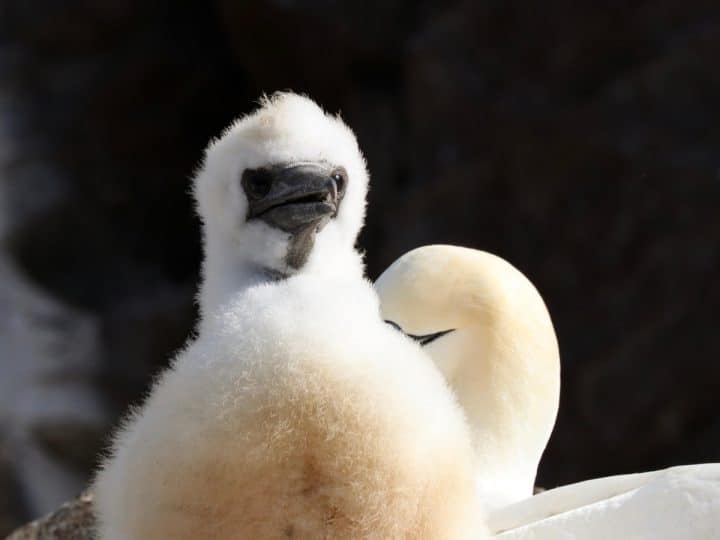
Two leading animal welfare organisations are calling on the new Scottish parliament to end the annual guga hunt on Sula Sgeir.
They’ve published a new report stating that the hunt cannot be considered humane, despite a NatureScot licence condition that requires killing must be carried out humanely.
This adds to the campaigning work of Protect the Wild, whose founder Rob Pownall ran for the Scottish parliament dressed as a gannet.
Animal Welfare and the Guga Hunt comes out as NatureScot considers a fresh licence application for the 2026 hunt. The topic is also due to for consideration by the Scottish parliament as it prepares to scrutinise a petition against the hunt that has attracted more than 100,000 signatures.
Scottish animal welfare charity OneKind worked with the League Against Cruel Sports Scotland to produce the new report. It examines the animal welfare implications of the hunt and identifies significant gaps in the legislative framework that governs it.
The groups submitted their report to NatureScot ahead of its decision on an application for a guga hunt licence in 2026.
The report finds that the method used to kill the young gannets, which are known as guga, carries significant welfare risks that cannot be adequately monitored or verified.
It also finds there’s been consistent underestimation of the disturbance of other vulnerable seabird species breeding on Sula Sgeir, including the highly protected Leach’s storm petrel.
Jason Rose, chief executive of OneKind, said:
This report is about the birds, what they experience during capture, during killing, and in the disturbance caused to the wider colony and other vulnerable species on the island.
The welfare risks we have identified are real and under current conditions they simply cannot be adequately monitored or mitigated.
The Scottish parliament, government and NatureScot all have a role in addressing the legislative gaps our report identifies, and we hope it contributes to that conversation.
Legislation around the guga hunt
On the legislative framework, the report’s findings note that Scotland’s animal welfare legislation only protects wild animals when they are under human control. While NatureScot requires humane killing of the birds by licence condition, animal welfare law doesn’t define the term humane and there is no independent oversight or monitoring on Sula Sgeir.
The report notes that ending the hunt would require only an amendment to the Wildlife and Countryside Act 1981. It currently contains a unique provision permitting the taking of gannets on Sula Sgeir for food. There’s no such exemption for any other species or location in Scotland.
The report’s findings sit alongside serious conservation concerns raised in a recent report by the Scottish Seabird Centre, which recommended that licensing of the hunt should end permanently.
The report, Assessment of the Guga Hunt in the Context of Seabird Conservation in Scotland, came out on 28 May. It noted that the gannet population on Sula Sgeir has declined by around 17% since 2017. And it’s the only Scottish gannet Special Protection Area where the population has fallen below the level it was at when the site gained protected status.
Robbie Marsland, director of the League Against Cruel Sports in Scotland and Northern Ireland, said:
Together, these reports make a compelling, evidence-based case why the guga hunt should come to an end.
This analysis sets out clearly why the hunt cannot currently be considered humane, and we hope it contributes to an honest, measured and constructive conversation about why this tradition can no longer be responsibly licensed.
For more than a century the League Against Cruel Sports has campaigned against traditions that harm animals. While we recognise the cultural significance of the hunt to the Ness community, the welfare of the birds matters too.
Both organisations are backing calls for a transition away from the guga hunt. To support this, they’d like to see initiatives that preserve and celebrate the Ness community’s cultural heritage. They also want to explore opportunities for local involvement in seabird monitoring and conservation on Sula Sgeir.
Featured image via Getty Images
By The Canary