

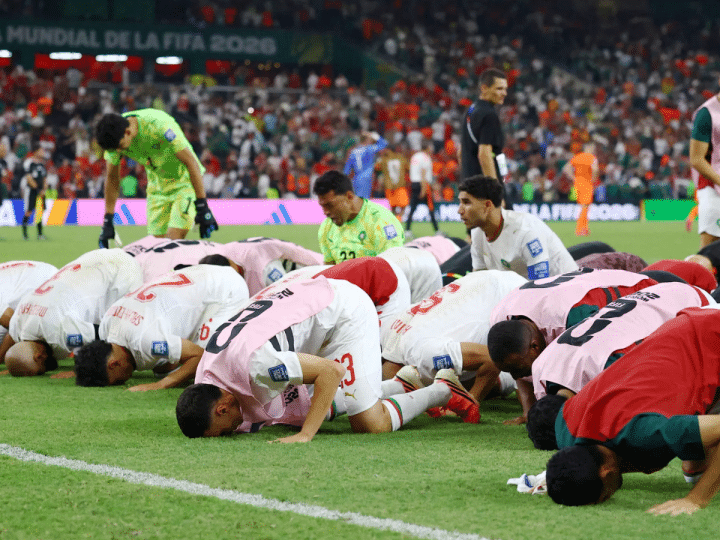
Morocco’s World Cup story keeps bending in unexpected directions, and in beautiful Monterey it took another sharp turn. Mohamed Ouahbi’s side, organised, stubborn and unshakably calm, edged past the Netherlands on penalties after a 1-1 draw to book a last‑16 meeting with Canada. It was a night where Morocco’s rhythm, passing ability, and speedy attacks got them the win in the end. The Dutch, for all their attacking talent, turned up to attempt a defensive masterclass which failed.
The Netherlands had arrived with momentum and expectation. Morocco arrived with big ambitions, but they left with more.
World Cup: Netherlands and Morocco start slow
The opening 45 never really opened up. The Netherlands had more of the ball, but clear chances were scarce. Cody Gakpo drifted off the front line, Cresencio Summerville looked for space on the break, yet Morocco’s block stayed compact and calm.
Morocco’s threat came in flashes. Ayyoub Bouaddi and Achraf Hakimi both tested Bart Verbruggen, the Dutch goalkeeper sharp enough to keep the game level.
The Moroccans weren’t chasing chaos. They were happy to keep the game tight, trust their plan. and wait for the right moment to commit numbers.
When Morocco broke, they broke with intent. Ismael Saibari peeled off defenders, Bilal El Khannouss carried the ball through pressure, and the wide players snapped into transitions. The Dutch did not have much of the ball, but Morocco also had the cleaner, sharper, dangerous moments in attack.
The match tilted in the 72nd minute. Summerville broke with pace, carried the ball into space and fed Gakpo, who finished clinically to put the Netherlands 1-0 up.
The goal landed with extra weight. Gakpo’s celebration was emotional, days after he and his partner Noa van der Bij revealed they had lost their unborn son. For a few minutes, it felt like his strike might define the night.
But Morocco didn’t flinch. They stayed in the game, stayed in their structure, and waited for their moment.
Morocco respond with precision
Extra time belonged, in terms of chances, to Morocco. They carried more threat, pushed higher and looked the likelier side to win it before penalties.
The best opening fell to Soufiane Rahimi. Clean through, one‑on‑one with Verbruggen, he seemed certain to score, but the goalkeeper produced what will be remembered as one of the saves of the tournament, deflecting the shot from point‑blank range.
That stop kept the Netherlands alive. It didn’t change the outcome.
Bounou and Saibari, cold as ice
In the shootout, Morocco leaned on experience and nerve. Yassine Bounou, already proven on this stage, read the Dutch takers well and saved from Summerville, while other Netherlands efforts failed to hit the target.
Morocco weren’t perfect from the spot, but they were steadier. Ismael Saibari stepped up for the decisive kick and buried it, sealing a 3-2 win on penalties and sending Ouahbi’s team into the last‑16.
No noise, no theatrics, just a group that has learned how to deliver on the highest level.
For Ronald Koeman, this will sting. His side had the lead, had the emotional surge after Gakpo’s goal, and still couldn’t close the game out. They were the second European team in a matter of hours to go out on penalties, following Germany’s defeat to Paraguay, and the questions around game management and mentality will linger.
The Netherlands had control in phases, but not enough incision, and once Morocco took control, the Dutch never fully wrestled it back.
World Cup business end
For Morocco, this fits a pattern: resilience, late punches, and clarity under stress. Ouahbi has built a side that can absorb, adjust and still carry a threat when legs are heavy and margins are thin.
They now face Canada in the last‑16 of the World Cup, another co‑host riding its own wave into the knockouts.
Morocco arrive there with something solid reputation, after a comeback built on detail, a shootout won on nerve, and a belief that they belong in the deep end of this tournament.
Featured image via the Canary
By Faz Ali