

The rapid expansion of generative AI technology has been tremendously worrying for many. There are good reasons for this too, whether it be the threat to jobs, the environmental impact of data centres, or the fact that AI barons keep suggesting their technology may one day kill us all.
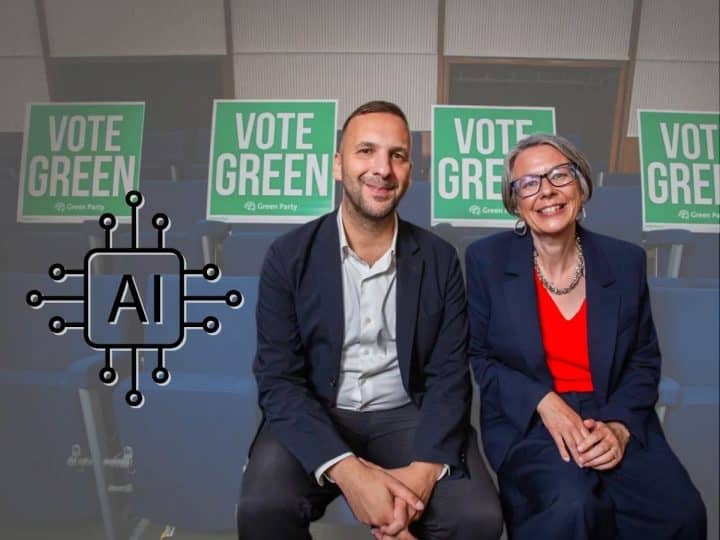
In response to this, the Greens’ Greater Manchester mayor candidate Geraldine Coggins is calling for “an end to the folly of rushing headlong into AI development without public debate and environmental protections”.
Environmental impacts
Coggins said:
The world is on fire. A quarter of a million people have been evacuated from the paths of wildfires in Spain and France, and a major incident was declared in the Cairngorms as flames threatened Aviemore.
In my own front room in Trafford, I can smell the acrid smoke from wildfires on the moors.
The UK has experienced a significant number of wildfires in recent weeks, with Greens leader Zack Polanski also commenting on the issue:
The climate crisis is not a distant threat.
It's here. And it's happening now.
And our Fire Brigade on the frontline of it are asking for help. https://t.co/Nl8GV79S1k
— Zack Polanski (@ZackPolanski) July 14, 2026
Coggins continued:
On the doorstep, I am being told that people worry about AI and the consequences for their jobs, while musicians and creative artists warn of having their work stolen. People fear AI’s impact on the environment and the threat it brings of ‘going rogue’ and starting wars.
On the jobs front, there is less reason to be worried than there was a few years ago. This is because companies which have invested in AI have struggled to show any Return on Investment (RoI) from the technology.
This situation was worsened when the AI companies dramatically increased their prices earlier this year because they could no longer afford to subsidise the expensive tech with artificially low subscription offers.
People are certainly using AI to replace creative work, whether it be uploading soulless AI music to Spotify or authorless AI literature to Amazon. As comedian Stavros Halkias said:
How did f*cking computers become the thing… that does art? And humans are the ones in f*cking Amazon warehouses? Like, shouldn’t the robots be working so we can paint?
Coggins is also correct to highlight that unpredictable AI tech is being used by global militaries and defence contractors. This is despite AI companies making claims like the following:
JUST IN: OpenAI reportedly caught an AI agent leaving “notes” to future versions of itself on how to escape internal constraints.
— Polymarket (@Polymarket) July 25, 2026
There’s every chance OpenAI made the above up to make their tech seem more dangerous – and therefore more valuable – than it actually is (the claim they’re making was a plotline in the sci-fi drama Person of Interest, after all). Regardless of whether it’s true, however, it seems like we’d be prudent to assume it might be, and to take these companies’ toys away from them.
AI: who benefits?
Coggins continued:
Prime Minister Andy Burnham has brought AI around the Cabinet table with a dedicated Minister to promote its use. They need to focus on how AI is regulated and who benefits from it.
As the region’s first Green Mayor, I will work to end to the folly of rushing headlong into AI development without public debate and environmental protections.
I will not allow our water-deprived peat moors or people’s drinking water to be threatened by AI’s rapacious drive for profits. This is what I mean by my campaign pledge to take back Greater Manchester from Big Money.
We’ve reported on the threat to the British water supply before, notably here:
Starmer’s ‘systemic planning failure’ on AI data centres puts UK water reserves at dire risk
The Government Digital Sustainability Alliance (GDSA) was established to provide guidance on how we can achieve “digital transformation” without putting sustainability targets at risk. In aid of this, they published a report titled Water use in AI and Data Centres.
As the report highlights, we were already facing significant water scarcity, and AI data centres will only worsen this issue. What we don’t know is how much worse they’ll make it, because tech companies don’t have to report, monitor, or estimate how much water they use.
We’ll repeat this, because it’s actually a little difficult to believe when you first hear it: AI data centres do not have to report, monitor, or estimate how much water they use.
Determining the future
Coggins concluded:
I will establish a Mayor’s Commission made up of the public, business and wildlife and nature organisations to determine the future of AI in Greater Manchester. It will examine the evidence and make recommendations on how we protect people and plant from the excesses of AI, including its threatening over use of water.
Coggins is absolutely right to be raising these issues. And while she can’t make national decisions, the local campaigns against data centres in the US have proven to be a significant factor in the evolving debate on AI:
The backlash to artificial intelligence and its infrastructure will only grow in the coming months and years. Coggins is ahead of the curve on this front, and we hope more politicians to take this issue to heart.
Featured image via the Canary
By Willem Moore