

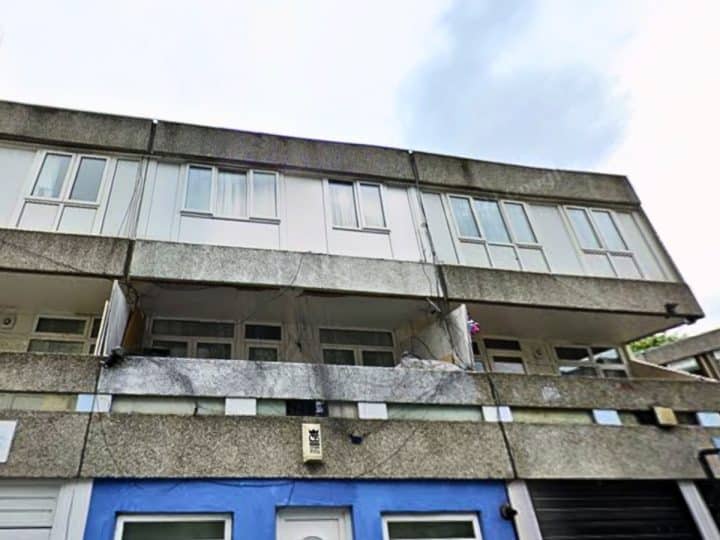
On 29 July 2026, the High Court will decide whether to grant permission for a judicial review of Bexley Council’s decision to approve Peabody’s plans to redevelop the Lesnes Estate. The brutalist development is better known as the ‘Clockwork Orange’ estate, and sits in Thamesmead, south-east London.
Adam Turk is a Lesnes resident and social tenant of Peabody Housing Association. He has brought the legal challenge with support from the Public Interest Law Centre (PILC). The estate gained recognition after appearing in the cult 1971 film A Clockwork Orange.
Turk has campaigned for tenants’ rights on the estate for several years and continues to oppose the proposed demolition. The PILC has supported tenants in resisting the demolition for several years. Preserving the estate is not only essential to protecting residents’ homes but also to reducing avoidable environmental harm.
The planning application fails to account adequately for the greenhouse gas emissions that would result from demolition and redevelopment. This is despite the availability of lower-carbon alternatives such as refurbishment or retrofitting. In light of the government’s plan to reach net-zero carbon emissions by 2050, retrofitting or refurbishment should be the first port of call over demolition.
The Lesnes legal challenge
Bexley Council’s planning officers resolved to grant Peabody’s planning application in October 2022. And they granted permission on 23 December 2025.
The proposed judicial review focuses on how Bexley Council assessed Peabody’s planning application.
The planning application required an Environmental Impact Assessment (EIA), supported by an Environmental Statement. Under established planning practice, known as the Rochdale envelope, an EIA must assess the likely environmental impacts across the full range of development that could be built under the planning permission. This must include assessing the worst-case scenario within the maximum development parameters.
Turk argues that Peabody failed to assess the realistic worst-case greenhouse gas emissions. Instead, it calculated emissions based on a single illustrative masterplan submitted with the outline application, rather than the maximum development parameters permitted.
Legal grounds
The challenge is based on two grounds:
- First, Turk argues that the council failed to apply the Rochdale approach because it didn’t assess greenhouse gas emissions using the full Rochdale envelope.
- Second, he argues that the officer’s report materially misled the planning committee. It gave little attention to greenhouse gas emissions and did not explain that it hadn’t assessed them using the required Rochdale approach.
Turk argues that the council could have reached a materially different outcome, had it assessed the greenhouse gas impacts correctly using the Rochdale envelope.
If the High Court grants permission for the judicial review to proceed, the case could have significant implications for the future of the Lesnes Estate redevelopment. And it could affect how local authorities assess the environmental impacts of major developments more generally.
Campaigners hope that less environmentally harmful measures, such as refurbishment or retrofitting, will be considered more thoroughly in estate redevelopments.
Too often, people’s homes are treated as expendable in the pursuit of profit. The PILC stands alongside tenants on estates like Lesnes, supporting communities as they challenge major developers.
Featured image via the Canary
By The Canary