
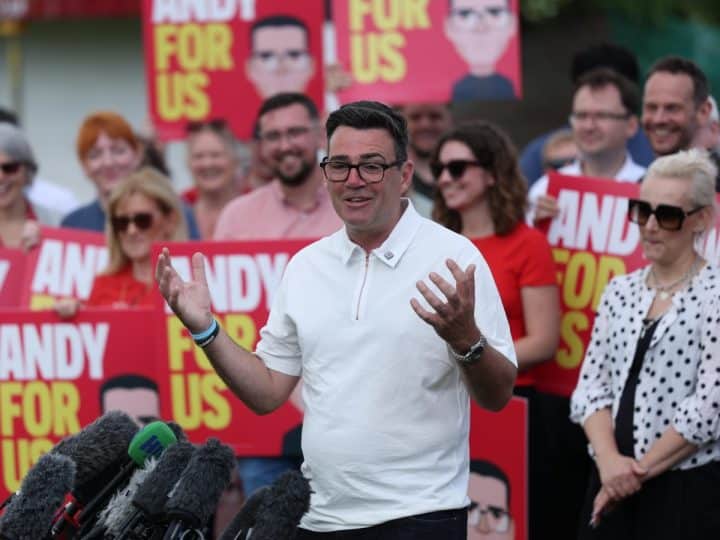
Andy Burnham’s back in Westminster after the Makerfield by-election. He’ll soon be Prime Minister. Which Andy turns up remains to be seen. And that, in part, will determine how much of a honeymoon he gets. If he guns for the privatised utilities and invests in council housing and public transport as he should, the establishment will target him. If he sits on the fence over Gaza, Palestine Action, or the EU, his coalition of voters will start to break apart. He’s one of the best communicators in politics – he can seem to offer everyone a little bit of hope. But as PM, you’re judged on actions.
Reform on the slide – or not?
Reform is on the slide. They hit their high point over a year ago, at the local elections. As I said then, once people saw them in power, they’d realise they have no solutions. Robert Kenyon, their candidate against Burnham, suffered the indignity of people actually paying attention to him.
In any other by-election, he could have slipped under the radar. Voters could have channelled their anger through him, imagining Kenyon as an eloquent champion of their personal grievances. But the unique circumstances of Makerfield attracted the glare of the studio lights. In a rare Question Time special, he looked like a naughty schoolboy. Told off for what were genuinely crass sexist remarks. Unable to apologise. We’ll never know the real breakdown, but he clearly repulsed the female voters of Makerfield. Reform has a women problem.
Kenyon was unable to even guess how Reform would deliver its policies. Which is hardly surprising, since every evaluation shows they are magical thinking. Farage is a one-trick pony. He does a good line in riling people up. “This is bad! That is awful! Blame the woke! Blame the immigrants!” But their solutions couldn’t pass a maths GCSE.
Farage is a bully. We know that from the dozens of people who’ve spoken about his school days at Dulwich College. Like all bullies, he’s also a coward. He left Makerfield before the result was called. Unwilling to appear on camera consoling his candidate. Unable to put on a brave face. He did the same in Gorton and Denton. And Caerphilly. This kind of weak leadership will damage his party. Without him, they’re a mess of conflict. As we’ve seen in Reform councils across the country.
A deception in Makerfield and beyond
Reform is essentially a deception. They pretend to be anti-establishment. Pro the British worker. But they want to strip equal pay rights from women. They voted against workers’ rights in Parliament. They take donations from overseas billionaires. Farage is on record as saying he wants to replace the NHS with private insurance. At heart, he longs to be an oligarch.
Makerfield showed that Reform’s support has come at a cost. People are starting to understand that a wave of angry, discordant posts from social media snowflakes puts more people off Reform than it wins over. Bots don’t vote.
Rupert Lowe’s Restore are even more openly racist. Lowe owned the label, saying, “If that makes me a racist, then so be it.” They polled 7% in what should be their heartlands. How long they’ll last and how many candidates they field in a general election will depend on how much money they take from billionaires. Or trillionaires, since Musk seems sweet on their particular brand of end-of-days race war. But if Reform starts to break apart, Restore will benefit. In May 1928, the Nazi Party polled only 2.6%. Five years later, they took power with 44% of the popular vote.
Makerfield wasn’t the only by-election yesterday. The Scottish Tories won in Aberdeen South by an even more spectacular swing than Burnham did in Makerfield. Labour’s bungling approach to clean energy was the major factor. Their vote plummeted. Offshore energy is the key industry there. Labour’s half-arsed approach has not created thousands of good green jobs. Naturally enough, people voted for a party offering them secure employment.
This is the heart of Andy Burnham’s dilemma.
Burnham’s dilemma
In Makerfield, he could say to people, “I know you hate Starmer. Vote for me, and I’ll get rid of him.” But when he’s PM, that cheat code is gone.
He inherits a government that believes in the magic growth bunny. The Office of Budget Responsibility and the Bank of England have been predicting growth every year for ages. They are always wrong. Even their forecasts at the start of the financial year are always wrong by the end of the year.
The reason is simple. Britain is now dominated by finance capital. Hoping that more deregulation, lifting caps on bankers’ bonuses, or giving more contracts to American big tech won’t change a thing.
Britain needs massive public-led investment in clean energy, public transport, and social housing. A retrofit programme would generate £3.20 for the economy for every £1 spent. It requires investment in skills training so people can do those jobs. Long-term commitments so supply chains and small businesses can gear up, knowing the work will be there for a decade or more. It pays for itself in increased tax revenue. We save on our bills, putting money in people’s pockets. And we get the environmental benefits for free.
Until someone comes up with a plan to tilt the economy away from billionaires in tax havens and in favour of the working people of Britain, easy answers from right-wing politicians will continue. I want to see the Green Party come up with a credible plan for government. Otherwise, we’ll be playing whack-a-mole with fascism while the rich get richer and the planet burns.
Featured image via the Canary